My soul doth magnify the Lord,
And my spirit hath rejoiced in God my Saviour
Because He hath regarded the humility of his handmaid:
for behold from henceforth all generations shall call me blessed.
Because He that is mighty hath done great things to me, and holy is His name.
And His mercy is from generation unto generations to them that fear Him.
He hath shewed might in His arm: He hath scattered the proud in the conceit of their heart.
He hath put down the mighty from their seat, and hath exalted the humble.
He hath filled the hungry with good things, and the rich He hath sent empty away.
He hath received Israel His servant, being mindful of His mercy.
As He spoke to our fathers; to Abraham and his seed forever.
Glory be to the Father, and to the Son, and to the Holy Spirit,
As it was in the beginning is now, and ever shall be, world without end. Amen
Except for the last two lines the text of the Magnificat describes the words Mary spoke to her cousin Elizabeth when she visited her. It comes from Luke 1:46-55. Basically she says she’s happy that she is blessed with child, and expects the child is going to do great things in the world. As was promised by God.
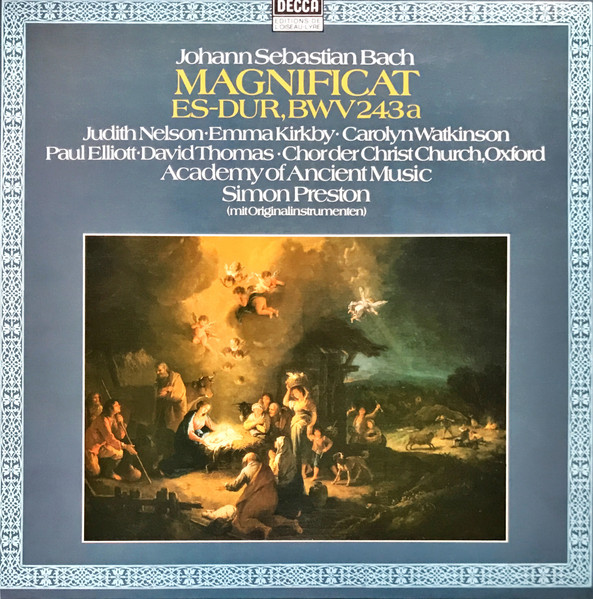
Bach composed it for the celebration of the Visitation, when he was Thomas Kantor in Leipzig, in 1723. This is the original version: most recordings use Bach’s revised edition, in D Major. This version is in E Flat Major. In that version Bach added some extra verses in celebration of Christmas called interpolations. These were customary at the time, but not part of the liturgy. Since this is noted as BWV 243a, they should be there, but I don’t see them mentioned on the title list on the cover.