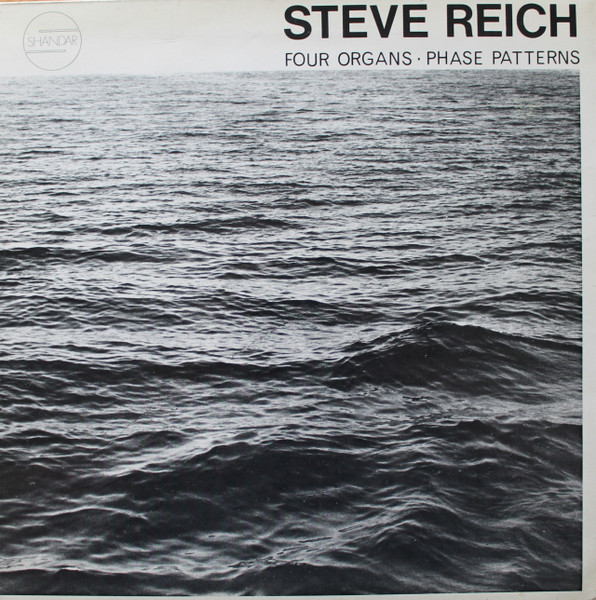
According to conductor and pianist Michael Tilson Thomas, at a performance of Reich’s Four organs, there was a woman walking down the aisle, to bang her head (or her shoe, depending on the source) on the front of the stage. She was yelling Stop, stop, I confess! I shared that feeling, without banging my head. This is a piece for minimalists.
The theory is interesting enough: take a single dominant 11th chord and gradually stretch, dissect and reassemble it over time. The idea is more like a laboratory of perception, where the listener is treated like a musical guinea pig. During the piece the mind will create harmonics that are actually not there. How long can you hear just one event, until your mind is filling in its own perceptions?
Already in the 60s, Reich worked on phasing, where he took different tape loops and slowly shift them out of alignment. In Slow motion sound he experiments with temporally stretching of a recorded sound. Both elements can be found in this revolutionary work from 1970. This record is the recording of the premiere in the Guggenheim Museum New York, 1970.
The second composition on this record is an earlier work (not much), where Reich experiments with acoustic phase shifting. Take four organs, with exactly the same timbre (basically the same model). Let them play a simple rhythmic pattern, repeating it. Then let one of them play it a little faster. The resulting difference leads to the perception of rhythm. Again, our mind is filling in stuff that really isn’t there, only to keep itself occupied in this minimalist world.